
Charleston County Booking Reports
Charleston County booking reports are maintained by the Charleston County Sheriff's Office through its Executive Information System. The Sheriff's Office operates the Sheriff Al Cannon Detention Center, one of the largest jail facilities in South Carolina. When someone is arrested in Charleston County, an Arrest and Booking Report is completed in the system and assigned a unique OCA number. These records are available to the public under South Carolina's Freedom of Information Act. You can search current inmate data online or contact the Records Division for copies of past booking reports in Charleston County.
Charleston County Quick Facts
Charleston County Sheriff's Office Records
The Charleston County Sheriff's Office is based at 3694 Leeds Avenue in North Charleston. The Records Division falls under the Support Bureau. A Records Manager and a Law Enforcement Records Coordinator handle all public requests for booking reports. The office processes records during posted business hours and follows all rules set by the Freedom of Information Act (§ 30-4-10).
Charleston County uses the Executive Information System, known as EIS, for all report work. Deputies must complete every report in the EIS under the Report Management System by the end of their shift. Supervisors then review each report for accuracy. If a report is not right, it goes back to the deputy for fixes. Records staff process each approved report into the EIS RMS. This system makes sure that booking reports in Charleston County are thorough and correct.
| Agency | Charleston County Sheriff's Office |
|---|---|
| Address | 3694 Leeds Avenue North Charleston, SC 29405 |
| Phone | (843) 202-1700 |
| Records | Records Division, Support Bureau |
The Records Division also handles all NCIC entries and removals during normal hours. After hours, the detention center's Records Division takes over NCIC work. Victims can get copies of reports at no cost. All other requests follow the county fee schedule for Charleston County booking reports.
EIS System and Booking Report Details
Every arrest in Charleston County creates an Arrest and Booking Report in the EIS. This applies to all physical arrests, including traffic offenses. Even when a juvenile is counseled, warned, and released, an Arrest and Booking Report is still completed. Each report gets an OCA number. OCA stands for Original Case Assignment. The Computer-Aided Dispatch system assigns these numbers.
The OCA format is simple. The first four digits show the year. Then a hyphen follows. Then six numbers that start at 000001 on January 1 each year. So the first case of 2026 in Charleston County would be 2026-000001. This system lets staff file and pull booking reports fast. If you have an OCA number, you can ask the Records Division for that exact report.
The Sheriff's Office requires documentation for several types of events. These include citizen reports of crimes, citizen complaints, all cases where a deputy is sent to look into something, and all arrests. When someone gets a citation instead of going to jail, that also gets a report in the EIS. Charleston County tracks every booking report through this same system.
Note: Reports that need more review stay in the EIS for each Bureau to check. This means some Charleston County booking reports may not be ready for public release right away.
Charleston County Master Name Index
The Records Division keeps an alphabetical Master Name Index, called the MNI. This index lists every person named in any field report. It covers victims, witnesses, suspects, and arrestees. It also includes businesses. The MNI is a core part of how Charleston County organizes its booking reports and other records.
When someone is booked at the detention center, staff check the Arrest and Booking Report for an existing MNI number. If the person has been in the system before, their old number is used. If not, a new MNI number is created. Every person gets one MNI number, and that number stays with them for all future arrests in Charleston County. Even unknown persons get an MNI number.
The RMS also keeps index files that sort incidents by type and by location. Stolen, found, recovered, or seized property is tracked too. This means you can search Charleston County records in many ways, not just by name. The MNI system makes it possible to link a booking report to other events tied to the same person.
The Charleston County inmate search portal at inmatesearch.charlestoncounty.org lets you look up current and past inmates. You can search by last name, first name, booking date, arrest date, or inmate number. There is also a checkbox to show past bookings. A ReCAPTCHA check is required before each search.
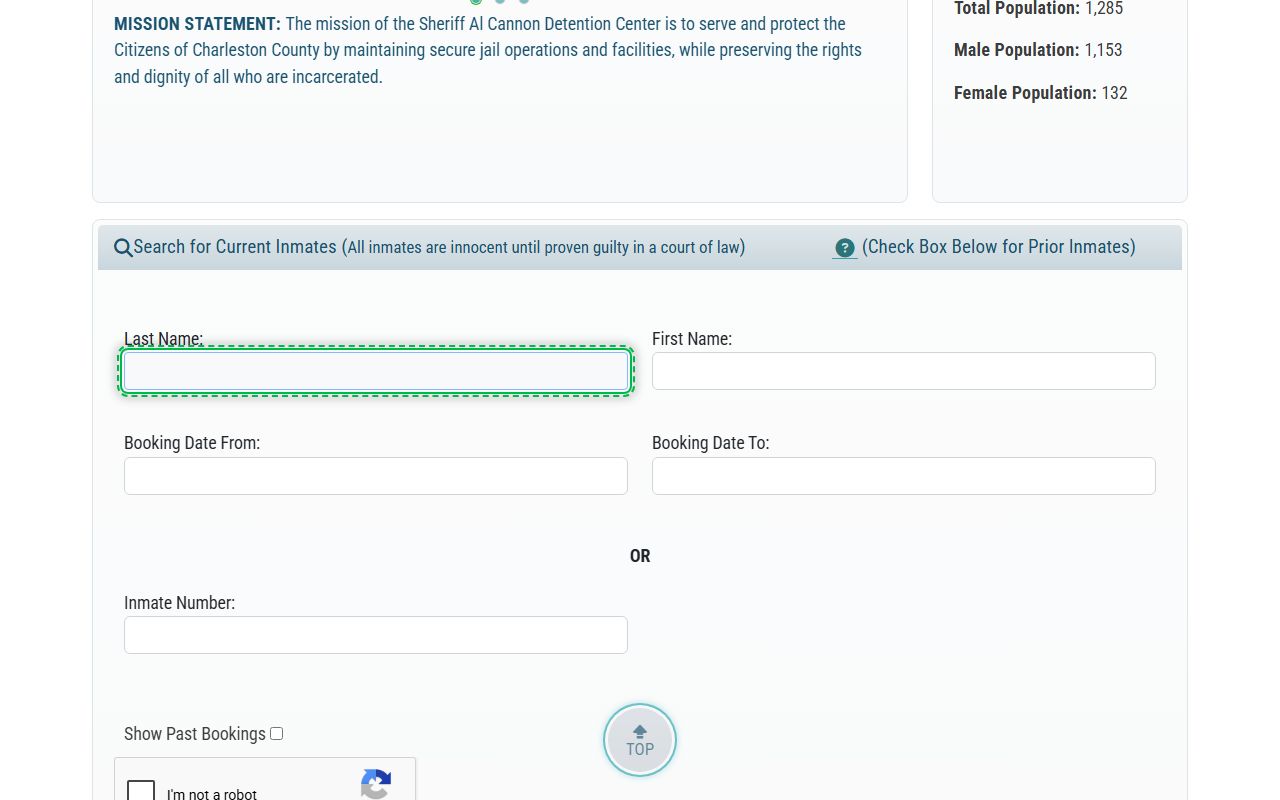
The online search tool shows names, booking numbers, charges, bond amounts, and mugshot photos for Charleston County inmates.
Sheriff Al Cannon Detention Center
The Sheriff Al Cannon Detention Center, also known as SACDC, is where all Charleston County bookings happen. The facility can hold up to 1,693 inmates across four buildings. Tower A, the original building, houses the Training Division, staff gym, inmate library, and eight housing units. A third expansion was done in May 2010, which raised the total capacity. In 2020, two modular units and the Work Camp were removed, which lowered the count by 224 beds.
At any given time, the detention center holds about 1,293 inmates. Of those, roughly 1,160 are male and 133 are female. These numbers change daily as people are booked in and released. The SACDC runs a cashless system. Inmates cannot have U.S. currency. Instead, each person has a canteen account. Money can be put into that account at a kiosk in the lobby.
Booking at the SACDC follows a set process. Staff record personal details, take a photo, and list all charges. The Dress-Out Department issues uniforms, linen, and hygiene items as the final step. The North Charleston processing location can be reached at (843) 554-5700. Dress-out happens at 11:00 a.m. every day and at 9:00 a.m. on Saturdays, Sundays, and holidays.
Inmate records at the SACDC include intake and booking data, NCIC background information, cash receipts, property receipts, court hearing dispositions, court orders, classification records, disciplinary reports, and grievances. Active records are kept for all current inmates. After release, inactive records stay on file for at least two years. Then they transfer to the County Records Office.
The facility is accredited by CALEA, the American Corrections Association, and the National Commission on Correctional Health Care. This triple accreditation shows a high standard for how Charleston County handles booking and detention.
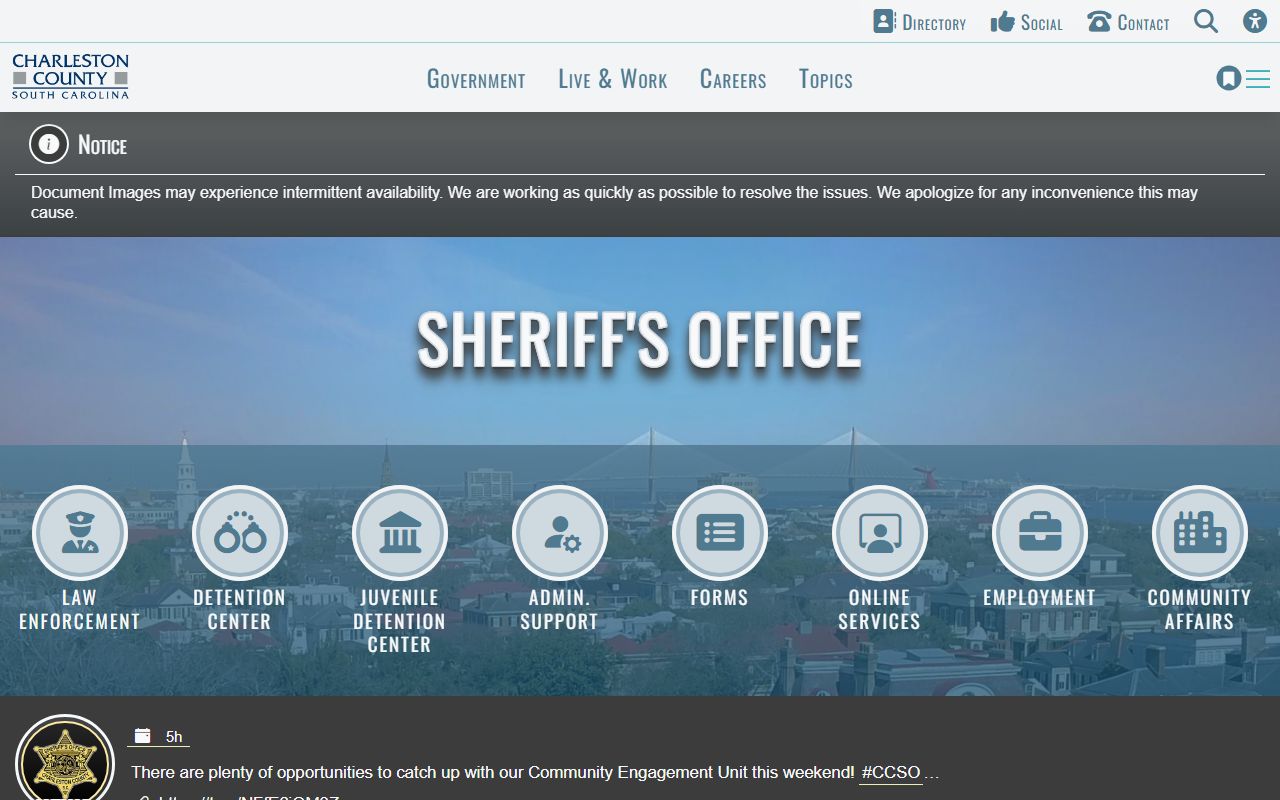
The Sheriff's Office website at sheriff.charlestoncounty.org has details on how to contact the Records Division and request Charleston County booking reports.
Visitation and Inmate Information
The SACDC uses video visitation only. There are no in-person visits. An inmate must be in custody for at least 72 hours before they can receive visits. The schedule runs Sunday through Saturday with three time blocks:
- 8:00 a.m. to 11:00 a.m.
- 1:00 p.m. to 4:00 p.m.
- 6:00 p.m. to 9:30 p.m.
Video visitation cuts down on contraband and reduces inmate movement inside the facility. All inmates at the SACDC are presumed innocent until proven guilty. The online search system shows current inmates by default. You must check the "Show Past Bookings" box to see people who have been released from Charleston County.
The VINE notification system is another way to track someone booked in Charleston County. VINE sends alerts when an inmate's status changes. It is free and works around the clock. This is useful for victims who need to know when someone is released.
Requesting Charleston County Booking Reports
Under the South Carolina Freedom of Information Act (§ 30-4-30), you have the right to request booking reports from Charleston County. The Records Division handles all FOIA requests. You can submit a request in writing, by email, or in person at the Leeds Avenue office.
Be specific in your request. Provide a name, date, or OCA number if you have one. The more details you give, the faster the search. Charleston County follows the county fee schedule for copies. Victims get their reports free. Law enforcement can also get copies at no charge for official use. All other requests are subject to standard fees.
The agency takes part in NIBRS, the National Incident Based Reporting System. This means data from Charleston County booking reports also goes to SLED at the state level. Records staff promptly remove all data when an expungement order is received. Under § 30-1-90(B), the county follows set retention schedules. Reports tied to capital crime cases are kept forever.
The Charleston County government website has links to various departments that can help with records requests.
Note: Some Charleston County booking reports may be restricted if they are part of an active investigation or involve sealed juvenile records.
State Resources for Charleston County
Several state-level tools can supplement your search for Charleston County booking reports. SLED's CATCH system lets you search criminal histories across South Carolina. The SCDC inmate search covers people in state prison. The South Carolina Judicial Department runs a public index for court case records.
Court records from the Ninth Judicial Circuit cover Charleston County. These records show what happened after the arrest. They include case status, hearing dates, and dispositions. Used together with booking reports, court records give you the full story of a case in Charleston County.
Nearby South Carolina Counties
Counties near Charleston also keep their own booking reports. Pick a county below for arrest records in that area.